What Happens When Car Accident Claim Exceeds Insurance Limits? Recovering Beyond Policy Limits
A serious car accident in Colorado can leave you with medical bills, lost wages, and rehabilitation costs that far exceed what the at-fault driver's insurance will pay. When your damages exceed the other driver's policy limits, you are left covering the gap unless you take legal action to recover from other sources. This guide explains how Colorado's insurance system works, where additional compensation can come from, and what steps to take right now if you suspect your claim is larger than the available coverage.
Key Takeaways
-
Colorado's mandatory minimum auto liability insurance is $25,000 per person and $50,000 per accident for bodily injury, plus $15,000 for property damage. Insurance companies pay only up to these policy limits after accidents, and serious injuries routinely cost more than these minimums cover.
-
You may recover compensation beyond insurance limits through your own underinsured motorist coverage, umbrella policies held by the at-fault driver, claims against multiple liable parties, or, in some cases, by suing the other driver for their personal assets.
-
Colorado's at-fault insurance system makes the driver responsible for crash damages, but it does not cap your total recovery if additional coverage or defendants exist. Comparative fault rules can reduce your award if you share blame, so early legal advice matters.
-
Do not accept a quick settlement offer for policy limits without having an experienced attorney evaluate your future medical costs, lost wages, and long-term impacts. Only about 4% of auto accident settlements exceeded policy limits in a 2014 study, but those cases often involved the most catastrophic injuries and the highest stakes.
-
If you have been hurt in a car accident in Pueblo or anywhere in Colorado and believe your claim may exceed insurance limits, call Johnston Law Firm, LLC at (719) 309-9484 or message us online for a free, no-pressure case review.
How Colorado Insurance Policy Limits Work After a Car Accident
"Policy limits" are the maximum dollar amount an auto insurance policy will pay for bodily injury and property damage after a car accident. Once the insurer pays up to that ceiling, its obligation ends.
Colorado law requires drivers to carry split limits: at least $25,000 per person / $50,000 per accident for bodily injury, and $15,000 for property damage. Many drivers carry exactly these minimums. Some carry higher amounts, but the numbers on the declarations page are the hard cap on what that insurer will pay.
Here is a concrete example of how a claim can exceed those insurance policy limits. Suppose you are rear-ended on I-25 and sustain a spinal injury requiring emergency surgery. Your medical bills reach $50,000, but the at-fault driver's bodily injury limit is $35,000. The insurance company pays $35,000. You are personally responsible for the remaining $15,000 unless you find other sources of compensation.
Even when the insurance company accepts liability and acts in good faith, it generally cannot be forced to pay more than the written policy limits. The policy is a contract, and the contract has a ceiling.
A Pueblo car accident attorney can investigate whether the other driver carries additional coverage, such as an umbrella policy or a commercial fleet policy from an employer, that expands the pool of available settlement funds.
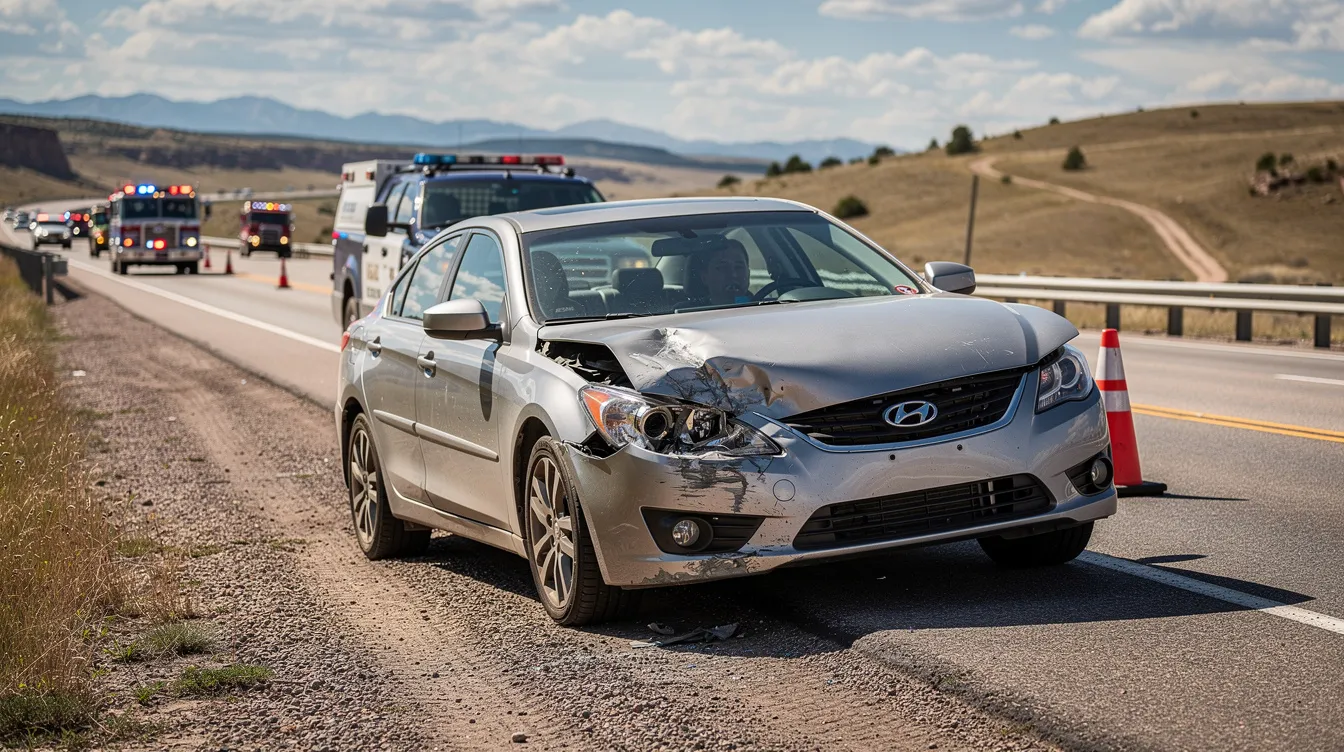
Colorado's At-Fault Insurance System and Financial Responsibility
Colorado uses an at-fault (tort) insurance system. Unlike no-fault states where each driver's own insurer pays regardless of who caused the crash, Colorado requires the negligent driver to cover the injured person's damages. The driver responsible for the collision, through their liability coverage, pays for bodily injury, property damage, lost wages, and pain and suffering.
The at-fault driver's insurance is the first source of payment. If the resulting damages exceed those liability limits, the injured person can look to other sources: their own insurance policy, other defendants, or even the at-fault driver's personal assets.
Colorado's comparative negligence rules add another variable. If you are found 20% at fault for the accident, your total recovery is reduced by 20%. When policy limits are already low, any shared fault can sharply reduce what you actually collect.
For comparison, states set different mandatory minimums. In Missouri, minimum liability coverage is required for drivers. Ohio requires minimum liability insurance coverage of $25,000 per person. Colorado's $25,000/$50,000/$15,000 split sits in a similar range, and all of these amounts can be consumed by a single ER visit and surgery.
Steve Johnston reviews police reports, witness statements, and insurance documents to help Pueblo and southern Colorado clients understand exactly how fault and policy limits interact in their specific case.
Why Serious Injuries Often Exceed Insurance Coverage
Collisions on I-25, Highway 50, and rural roads throughout Otero, Fremont, Custer, Huerfano, Las Animas, and Crowley Counties can produce injuries whose medical costs dwarf minimum policy limits within days.
Common severe injuries include:
-
Traumatic brain injuries requiring ICU stays and cognitive rehabilitation
-
Spinal cord damage leading to partial or permanent disability
-
Multiple fractures needing surgical repair and hardware implantation
-
Internal organ injuries requiring emergency surgery and extended hospitalization
Damages in auto accident settlements account for more than immediate medical bills. They also include ongoing treatment, assistive devices (wheelchairs, prosthetics), home modifications (ramps, accessible bathrooms), and future lost wages or reduced earning capacity.
Consider a Pueblo resident hospitalized after a head-on collision: emergency surgery ($40,000), twelve months of physical therapy ($18,000), four months off work ($16,000 in lost wages), and a wheelchair ramp at home ($3,500). The total exceeds $77,000, which is more than three times the $25,000 per-person minimum and well above even a $50,000 bodily injury limit.
Settlements exceeding policy limits are rare but possible in severe cases. Accepting the first settlement offer before a qualified personal injury attorney fully evaluates future medical needs and long-term impacts can leave tens of thousands of dollars on the table.

Common Sources of Additional Compensation Beyond Policy Limits
When an at-fault driver's coverage is not enough, an experienced automobile accident attorney will systematically look for every available source of additional compensation. Identifying all responsible parties can increase recovery well beyond a single policy's cap.
Potential sources include:
-
Your own uninsured/underinsured motorist (UM/UIM) coverage paid under your own auto insurance policy
-
Medical payments coverage (MedPay) on your policy, which pays regardless of fault
-
Umbrella or excess liability policies held by the at-fault driver or their employer
-
Multiple at-fault drivers, each with separate insurance policy limits
-
Employer or commercial insurance policies when the other driver was working at the time of the crash
These sources can be layered together to close the gap between the at-fault driver's policy limits and the full amount of your bodily injury, lost wages, and pain and suffering. Multiple liable parties can increase available compensation beyond what any single policy provides.
Steve Johnston's practice across Colorado includes investigating complex coverage layers and identifying all responsible parties. The goal is to leave no policy unexamined.
If you think your car accident damages may exceed the other driver's insurance, call Johnston Law Firm at (719) 309-9484 or send us a message online so we can begin a detailed insurance and asset review for your case.
Using Your Own Underinsured Motorist Coverage (UM/UIM)
Underinsured motorist coverage is a provision in your own auto insurance policy that pays when the at-fault driver's liability limits are too low to cover your damages. Under C.R.S. § 10-4-609, Colorado auto insurance policies must include UM/UIM protection unless the policyholder rejects it in writing.
UIM coverage pays the difference between the at-fault driver's liability limits and your actual damages, up to your own UIM policy limits. Underinsured motorist coverage may cover medical expenses and lost wages that remain after the at-fault driver's insurance is exhausted.
Many drivers do not realize they have underinsured motorist benefits available. Insurers are not always forthcoming about explaining how these benefits work or how much they are worth in a given case. In Louisiana, underinsured motorist coverage pays damages up to its limit, and it is optional there. In Colorado, the law requires that insurers offer UM/UIM in an amount equal to your bodily injury liability limits. Underinsured motorist coverage is optional in many states, including Louisiana, but Colorado's statutory framework gives policyholders stronger protections if they did not affirmatively reject it.
Pursuing a UIM claim can be adversarial. Your own insurer may hire independent medical examiners, challenge your diagnoses, or dispute the cost of future care. Accurate documentation of every medical visit, work restriction, and out-of-pocket expense is essential to counter these tactics.
Johnston Law Firm regularly reviews clients' policies for UM/UIM language, calculates the total potential recovery, and negotiates firmly with insurers that undervalue Pueblo and southern Colorado injury claims.
Multiple Liable Parties and Commercial Insurance Policies
Some crashes involve more than one negligent driver. Multiple drivers can share liability for an accident; for instance, if two vehicles run a red light simultaneously and collide with you, each driver (and each driver's insurer) bears a share of responsibility. You can sue multiple defendants for damages in an accident.
Employer liability claims can increase available compensation when a driver causes a collision while performing job duties. Under the doctrine of respondeat superior, the employer may be liable alongside the employee. Commercial policies often have higher limits than personal auto policies; trucking and fleet policies routinely carry $750,000 to $1 million or more in liability coverage.

In more complex cases, other defendants could include:
-
A vehicle manufacturer (defective brakes, faulty airbags)
-
A maintenance or repair shop that failed to fix a known issue
-
A governmental entity responsible for a dangerously designed or poorly maintained roadway
Identifying all negligent parties and all applicable policies is one of the primary reasons to work with an experienced Colorado automobile accident attorney rather than relying on the at-fault driver's insurer alone.
Umbrella and Excess Insurance Policies
Umbrella and excess liability policies sit on top of primary auto insurance and activate once primary policy limits are exhausted. Umbrella policies provide additional liability coverage beyond auto insurance limits, and they provide additional coverage beyond standard limits as well.
Higher-income individuals and many businesses in Colorado carry umbrella coverage of $500,000, $1 million, or more. When such a policy exists, the settlement value of a severe car accident case changes substantially.
Insurance companies do not always volunteer information about umbrella policies. Uncovering them may require formal demand letters, subpoenas, or litigation discovery. A knowledgeable personal injury attorney knows how to use these tools to determine whether any umbrella or excess policies cover the negligent driver or their employer.
When umbrella coverage is confirmed, it may pay for additional bodily injury damages, lost wages, and other losses that exceed ordinary policy limits, bringing the total available compensation much closer to the full coverage the injured person needs.
Suing the At-Fault Driver Personally for an Excess Judgment
When injuries are severe and insurance coverage (including umbrella policies) still falls short, you can sue the at-fault driver personally for damages. An excess verdict allows suing for personal assets that go beyond what insurance covers.
An "excess judgment" is the portion of a court verdict that exceeds all available auto insurance and umbrella coverage. If a jury awards $200,000 and the at-fault driver's total insurance pays $100,000, the remaining $100,000 is an excess judgment against the driver individually. An injured party can file a personal injury lawsuit against the at-fault driver for the excess amount.
Collecting judgments can be difficult if the driver is broke. Creditors can pursue your non-exempt personal assets to satisfy a court judgment, which means bank accounts, investment accounts, rental properties, and other valuable property may be reachable. However, Colorado law protects certain assets, including portions of home equity and retirement accounts.
A court may order wage garnishment to pay down a judgment against the at-fault driver. Colorado District Court judgments are valid for 20 years, with options to revive before expiration, while County Court judgments last 6 years. Bankruptcy may be an option if the at-fault driver is unable to pay an excess judgment, which can complicate collection.
The other party may also negotiate a direct settlement for the difference out of their own savings rather than go through protracted litigation.
Steve Johnston can analyze the at-fault driver's financial situation, advise whether an excess claim is practical, and, when appropriate, seek court judgments that go beyond insurance policy limits.
Bad Faith Claims Against Insurance Companies
Colorado insurers have a duty of good faith and fair dealing. They must handle claims honestly, reasonably, and promptly.
Examples of potential bad faith behavior in high-value car accident cases:
-
Unreasonably refusing to settle within policy limits when liability is clear
-
Ignoring documented evidence of serious injuries
-
Delaying payment without justification
-
Misrepresenting policy terms or claim status
If the injured party offers a settlement within the at-fault driver's policy limits and the at-fault driver's insurer refuses to accept it, that insurer may be responsible for the excess judgment that results from trial. This is one of the most consequential bad faith scenarios.
Under C.R.S. §§ 10-3-1115 and 10-3-1116, Colorado's statutory bad faith provisions prohibit unreasonable delay or denial of benefits owed under first-party insurance policies. Common law bad faith requires proof that the insurer acted unreasonably with knowledge or reckless disregard for the lack of a reasonable basis.
Bad faith claims are complex and fact-intensive. They require careful documentation of all communications, offers, and claim-handling steps between you, your attorney, and the insurance company.
Johnston Law Firm can review adjuster notes, correspondence, and claim files for signs of bad faith and, when appropriate, pursue separate legal action to hold insurance companies accountable.
Evidence and Early Investigation in High-Value Colorado Car Accident Cases
When medical bills and lost wages may exceed policy limits, preserving evidence becomes even more critical to maximum compensation.
Key types of evidence to gather quickly:
-
Police crash reports and traffic citations
-
Photos and video from the scene, including dashcam or surveillance footage
-
Black box or telematics data from involved vehicles
-
Witness statements with contact information
-
Complete medical records from providers in Pueblo and across Colorado
-
Employment and wage records documenting lost income
In commercial vehicle or trucking cases, time-sensitive evidence such as driver logs, maintenance records, dispatch data, and inspection reports can disappear unless prompt preservation letters are sent. Trucking companies are required to retain certain records, but delays in requesting them can result in "routine" destruction.
Strong evidence not only proves fault but also counters insurance arguments about comparative negligence or pre-existing conditions in high-value injury claims.
Johnston Law Firm conducts early, thorough investigations and works with accident reconstruction experts, medical specialists, and vocational analysts when necessary to build strong cases for clients throughout southern and central Colorado.
How Policy Limits Affect Auto Accident Settlement Strategy
Knowing all applicable insurance policy limits on all sides is essential to setting realistic settlement goals and deciding whether to push a case toward trial.
An attorney weighs several factors when recommending whether to accept a policy-limits offer:
-
Severity of bodily injury and projected future medical treatment
-
Impact on the client's ability to work and perform daily activities
-
Total "stack" of available insurance coverage (liability, UIM, umbrella, commercial)
-
Strength of evidence on liability and damages
-
Cost and time of trial versus expected benefit
Settlement negotiations often proceed in stages. First, the attorney works to exhaust the at-fault driver's policy limits. Next, UIM carriers and umbrella carriers are pursued. Then, claims against other defendants proceed if applicable.
Accepting a policy-limits settlement from one insurer without properly structuring the release can jeopardize your ability to collect from other policies. A release worded too broadly can unintentionally waive your UIM claim or your right to pursue other defendants.
Steve Johnston regularly advises Pueblo and statewide clients on how to coordinate multiple settlements and protect their right to pursue every available dollar of compensation.
What To Do Immediately If You Suspect Your Claim Exceeds Insurance Limits
Early actions can determine whether you recover the full amount of your damages or leave money uncovered. Here is what to do:
-
Get prompt medical evaluation and follow-up care. Document all diagnoses, treatment plans, work restrictions, and out-of-pocket costs. Gaps in treatment give insurers ammunition to minimize your claim.
-
Avoid giving detailed recorded statements to any insurance company, especially the other driver's insurer, before speaking with a car accident attorney. Statements made in the days after a crash are routinely used to reduce the value of your settlement.
-
Gather and organize copies of police reports, medical bills, wage records from your Pueblo or Colorado employer, photos of injuries and vehicle damage, and any written communications from insurers.
-
Check your own insurance policy for underinsured motorist coverage, collision coverage, and MedPay. Request your declarations page showing your liability limits and UIM limits.
-
Contact a lawyer. Call Johnston Law Firm at (719) 309-9484 or reach out online as soon as you realize your medical costs or lost income may outstrip the at-fault driver's insurance limits.

Why Work with Johnston Law Firm, LLC on a Policy-Limits Case?
Serious auto accident cases where total damages exceed insurance policy limits require a lawyer who understands both Colorado injury law and the insurance system from the inside out.
Steve Johnston has been practicing since 2002, handling personal injury, automobile accidents, workers' compensation, Social Security disability, criminal law, and estate planning for individuals in Pueblo and across Colorado, including Otero, Fremont, Custer, Huerfano, Las Animas, and Crowley Counties.
The firm's approach is hands-on: direct access to your attorney, clear explanations of your legal options, and a roadmap of how the case will unfold from free consultation through negotiation, litigation, or trial if necessary.
Many personal injury and automobile accident cases are handled on a contingency fee basis, so clients typically pay no attorney fees unless the firm recovers compensation for them.
Schedule a free consultation by calling (719) 309-9484 or by using the secure contact form to tell us about your accident. The call costs nothing, and it could change the outcome of your case.
Frequently Asked Questions About Claims That Exceed Insurance Limits
If the other driver only has Colorado's minimum insurance, is that all I can ever recover?
No. While the at-fault driver's minimum liability coverage caps what their insurer must pay, it is not the total cap on your recovery. Additional sources such as your own UIM coverage, umbrella policies, or claims against other liable parties may provide more compensation. Each case stands on its own merits; a Pueblo car accident lawyer can review all available insurance policies and potential defendants to determine whether recovery can go beyond the at-fault driver's insurance limits.
Will my own insurance rates go up if I use my underinsured motorist coverage?
Colorado law generally prohibits insurers from surcharging or non-renewing policies simply because the policyholder made a UM/UIM claim after an accident they did not cause. Insurers may consider your overall claims history, but making a UIM claim when another driver hit you is not treated the same as an at-fault accident. An attorney can help you understand how a particular UIM claim might affect your relationship with your insurer and can negotiate directly with the company on your behalf.
How do I know what the other driver's policy limits actually are?
Insurers do not always disclose policy limits informally during early negotiations. An attorney can obtain this information through formal demand letters, negotiation, or, if a lawsuit is filed, through discovery tools such as interrogatories and requests for production. Without knowing all applicable insurance policy limits, evaluating whether a settlement offer is fair is a challenging situation, which is why legal representation is important in serious injury cases.
Can I settle with the at-fault driver's insurer and still make a UIM claim?
Yes. In Colorado, you can usually pursue UIM benefits after exhausting the at-fault driver's liability coverage. However, the sequence and language of releases must be handled carefully to preserve your UIM rights. If a release is drafted too broadly, it can unintentionally waive claims against your own insurer or other potential sources of recovery. Working with an attorney before signing any settlement paperwork is critical.
How soon should I contact a lawyer if I think my claim will exceed policy limits?
Contact a lawyer as soon as you realize your injuries may be serious. Within days or weeks of the crash is ideal. Early involvement preserves evidence, protects deadlines, and allows a thorough investigation of all available insurance coverage and liable parties. Many people lose potential recovery simply because they waited too long to explore their full legal options.
Call Johnston Law Firm, LLC at (719) 309-9484 or send us a message online for a free, confidential discussion about your rights and options.